How I think I’m writing: Using eye contact, or lack thereof, to display emotions such as intimacy, shock, denial, or nervousness.
How I’m actually writing: She looked at me, and I looked away. I tried to look back, but she was already looking at the sky. “Look,” she sighs, looking back at me for a split second. “I don’t know how to say this.” We looked at each other and time stopped, but then she looked her lookers at something else to look at, looking tired.
Hello! This blog was recommended to me by a writing professor, in regards to the novel I’m currently planning in class. I had a couple questions I hope you could clear up.
-My main character is a black man. His mother always told him white women were the devil, due to a literal bargain with the devil who appeared to her during a summoning as a white woman. Ignoring his mother, he settles down with a white woman. When she dies under mysterious circumstances, he finds the town that once pretended to respect him liked him a lot less than they let on. The first part of this question, I suppose, is is it a savior’s narrative if my novel addresses PTSD, fear of the dark, racism in small towns, and police brutality? Along, of course, with random occult under themes to address the historical fire under Centralia, PA. My professor believes that to be the case, though I am uncertain.
-What DOES constitute as savior narrative? As of today, I believed it was the narrative that it takes a white person to show up and make everything all better. Is the fact that I’m a white author make it instantly a savior narrative?
Aw, so cool that your professor recommended us!
Anyhow, I’ve read over this question a few times and don’t see where your details would connect to a white savior narrative.
White Savior, in short, relates to white people saving People of Color.
It could be from circumstances (e.g. financially poor PoC, White people in “Africa” …who also don’t even bother to mention/know the African country they’re in!)
It might be from themselves or their own bad decisions
As mentioned in “Is this the white savior trope?” – on our common misconceptions II post:
If you have a story with a sympathetic or kind white character, that doesn’t mean it’s the white savior trope. The problem with the white savior is that it centers POC’s realities and stories on whiteness. The only time so many of our stories get told is through whiteness, like Dances With Wolves, The Last Samurai, etc. Whether or not the white protag is a jerk or genuinely being helpful isn’t the only issue.
So, not seeing a white savior in your particular storyline.
Is the fact that I’m a white author make it instantly a savior narrative?
I think your last question is spot on; I think your professor may have been warning that you, the author, are leaning towards becoming “the white savior” from your approach to these subjects.
You’ve got:
Black intercommunity issues (dating outside race and mistrust of white people/women)
Personally, I cannot recommend writing this for all the ways it can and does go wrong. I also don’t feel like in the climate of the world, especially my world in America, I need a book like this right now. I’m sure others agree as well. There’s not much you can teach me with this book, especially as a non-Black person, who also sees what is happening around me and is affected by it.
As for those it may teach, i’m more comfortable with a Black voice imparting that authentic perspective vs. someone outside of the community.
There are questions you should ask yourself before tackling such a book:
Why are you writing about this subject?
Are you qualified to write it? If you’re trying to teach readers a lesson about racism: if you cannot experience racism or anti-blackness yourself, I would not trust your qualifications.
What is your message? What does your book intend to say blatantly and also what does it imply subtly?
Does it hurt/benefit the people?
Does it portray the people in a three-dimensional matter or is it a one-sided story of pain and struggle? How proportional are your happy/normal moments to the struggles?
Can you comfortably represent these people’s culture and daily life?
Does your voice add to the conversation or attempt to dominate the discussion?
Have you talked to the people you’re writing about (regarding your ideas/ events in the story)?
Has your ideas and actual story been/going to be beta-read by the people at hand?
There are also things you should do before tackling such a book:
Become as close to an expert as possible. This requires extensive research. (Books alone will not do. You need to talk and work with people in the community. Scourge blogs, conversations, know the history, etc. See WWC Research Posts)
Have sensitivity readers. They should review everything from your concepts, the work in process, and final product. (I’d recommend someone you pay and can be brutally honest, not just a friend)
Know your limits. You simply cannot write about what racism feels like or what it’s like to be an X, if you haven’t experienced it. Be aware of your perspective.
Consider addressing issues on a smaller scale. This could mean scaling down the number of issues you focus on, and/or making one of the race topics just one aspect of the plot vs. the plot. This seems more manageable, especially if you have never written on the topic before.
…Or smaller Issues altogether: Another idea would be to practice covering the tough topics. For example: writing a story that incorporates micro-aggressions into a Character of Color’s life without any aggressive racism, and then working your way up in this WIP.
Consider a co-writer. Maybe you shouldn’t write this work alone. What about inviting a voice to the work who has first-hand experience in the topic?
Balance the struggle. Even stories that cover the hard stuff should not be all about struggle. You need moments of light, breaks from the pain, sweet with the bitter, or else it’s just needless suffering that simply hurts to read.
Don’t speak over us/for us: If you’re white, your story naturally comes with privilege. People are more willing to listen to a white person talking about People of Color’s issues than actual People of Color themselves. That’s why a book like this should work with that privilege to actually center the struggles of the people at hand. Don’t make it about you or the white characters and certainly to not excessively highlight or victimize them. As a white writer, become as invisible as possible.
Know your book will likely be highly criticized and rejected. At least by the community. You’re going to get stuff wrong. You’re also going to get stuff right, but people aren’t comfortable with who is speaking that truth when it could be someone more qualified speaking it. These are all valid reactions.
If you’re not sure how to describe her appearance, you can describe how she acts. Talk about how she sucks in her stomach to squeeze between desks or how she tries to make herself look smaller when she’s in a crowd. Or, alternatively, how she walks proudly with her shoulders back and her stomach leading the way. How she swings her hips confidently and looks back over her shoulder at the person she knows is checking out her luscious booty.
Focus in on how she feels about being chubby. Does she like her body, or is she self-conscious about it? That will affect how she moves, how she dresses, even just how she sits next to someone. Does she wear baggy clothes in an attempt to seem smaller than she actually is? Does she wear crop tops and leggings and show off her curves? You could even talk about where she shops. If she’s a much larger size, she might not be able to go to the same stores as other characters in your fic.
Body language changes from person to person, and body shape can inform that language. Dig deeper into the character than just her outward appearance, and that will help you round her out in more than just her hip region 😉
One potential trap I’ll caution you to avoid is to signal her size by writing her constantly eating or eating poorly. That’s a trope that just needs to stop. There are lots of reasons why people have different sizes, and diet is just one of them. If you don’t spend a lot of time describing how other characters eat, I’d skip it with her as well.
I’m somewhat more than chubby myself, so that’s how I’d go about it – but then that’s my own experience. Your readers might or might not appreciate that approach.
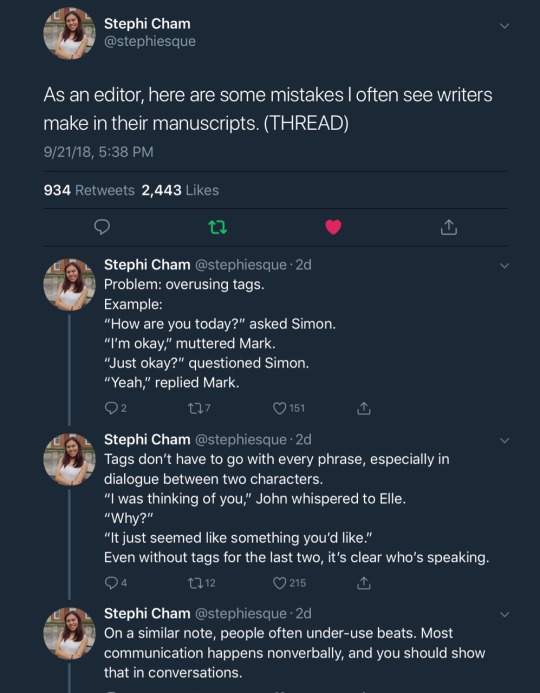
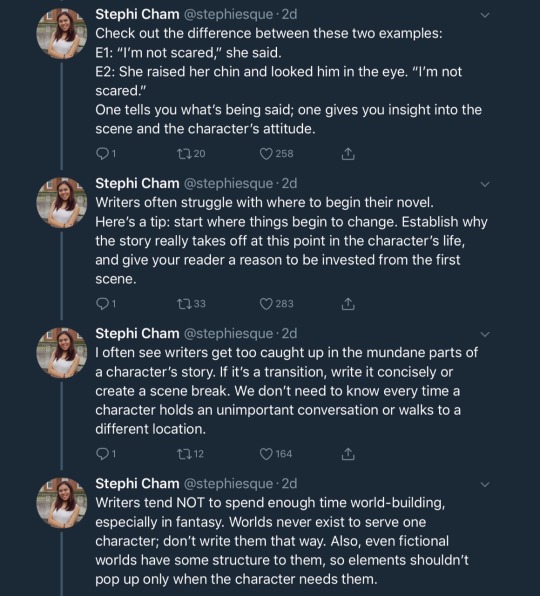
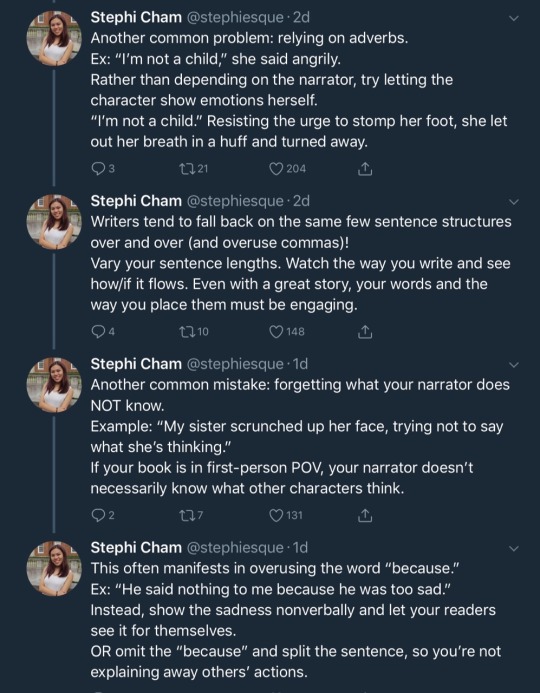
This. This is good fiction writing advice. I really appreciate how it was formatted as “this is a common problem, here is a solution to try in your own work” and not “oh god, don’t do that!” without any extra help. And I extra appreciated the “don’t rely on adverbs” bit, because they do have their place but they aren’t the only way actions can be emphasized.
Something that’s almost never covered in fantasy mediums is common names.
Like we all know fantasy names are unusual, but any name to a foreign culture is considered unusual English names to Indian people are very unusual for example. But naturally, given that it’s an entire culture, there will be some common names, it’d be refreshing to at one point here this exchange.
“So I was talking to Vicnae and-”
“Wait which Vicnae? You can’t just say Vicnae. There are ten Vicnae’s in my village alone.”
This has 100 notes yesterday and 300 this morning what the fuck happened.
People understand the truly important things.
DSA (a German fantasy P&P RPG) actually has the name Alrik, which is hugely popular in the universe. Everyone is Alrik.
This is also a great excuse to use “X the Y” or “X of Y” type names without being pretentious. Calling someone “Thognor The Stout” goes from pomposity to practicality if he lives down the road from Thognor The Small.
my family is from a town in Ireland where everyone has the last name Ryan. literally like everyone. so they differentiated families by calling them by their professions, right?
anyway we’re the Horse Thief Ryans
This will even happen within families-
On my mom’s side, every boy was named “Robert” and imediately shortened to “Bobby” for six generations, to the pint where angrily yealling “ROBERT!” at thanksgiving would make easily 20 men jump in terror. We started distinguishing them by phsycial attribute- Tall Bobby, Short Bobby, Bald Bobby, Shooting Accident Bobby and my favorite uncle “Rock n Roll Bobby”)
On my Dad’s side, I’m related to pretty much everyone in the Cear Rapids area with the Surname “Gray”. However, the Grays are Gotdam Humoungous family (7 children, 32 grandchildren, 86 great grandchildren and oh god I’m not sure how many great-great grandchildren they keep happening and some of them are old enough to marry now…) so to distinguish my degree of relation (mostly becuase none of us can remember what the difference between numbering and removing your cousins is) they’re distunguished by which piece of the empire they control- Corn Grays, Real Estate Grays, Dry Cleaning Grays, Junkyard Grays, The Other Corn Grays, Waste Management Grays, Funeral Home Grays and The Other Other Corn Grays.
See, the problem with people who aren’t in wheelchairs writing about and/or drawing people who are in (manual) wheelchairs is that the people who aren’t in wheelchairs tend to think that there’s only like four movements that you do in a wheelchair. You can either push forward, push backwards, turn left, or turn right. And the characters do it all while sitting up straight or bending forward so that their noses touch their knees.
But the amount of motions that I go through on a daily basis are actually amazing. And the body language…you could write an entire book on the body language of someone in a wheelchair.
Like right now, I’m more relaxed, so I’m slouching slightly. I’ve got my right foot on its footrest and the left foot on the ground. Every so often, as I stop to think of something to say, I’ll push with my left foot to rock the chair slightly.
But usually, I sit mostly upright with my upper-half slightly leaned forward. When I’m wheeling across the campus, especially if I have somewhere that I need to be, I’ll lean and shift my weight in whichever direction it is that I’m going. It helps make the wheelchair glide that much more smoothly. How far/dramatically I lean depends on how fast I’m going, the terrain, if there’s a turn, etc.
Plus people who don’t use wheelchairs don’t understand the relationship between grabbing the wheels, pushing, and the chair moving. Like I’ve seen things written or have seen people try to use a chair where the character/that person grabs the wheel every single second and never lets go to save their lives. Which isn’t right. The key is to do long, strong, pushes that allow you to move several feet before repeating. I can usually get about ten feet in before I have to push again. It’s kind of like riding a scooter. You don’t always need to push. You push, then ride, then push, then ride, etc.
And because of this, despite what many people think, people in wheelchairs can actually multitask. I’ve carried Starbucks drinks across the campus without spilling a single drop. Because it’s possible to wheel one-handed (despite what most people think), especially when you shift your weight. And if I need to alternate between pushing both wheels, I’ll just swap hands during the ‘glide’ time.
I’ve also noticed that people who don’t use wheelchairs, for some reason, have no idea how to turn a wheelchair. It’s the funniest thing. Like I see it written or, again, have seen people ‘try’ a wheelchair where they’re reaching across their bodies to try to grab one wheel and push or they try to push both wheels at the same time and don’t understand. (For the record, you pull back a wheel and push a wheel. The direction that you’re going is the side that you pull back.)
Back to body language. Again, no idea why most people think that we always sit upright and nothing else. Maybe when I’m in meetings or other formal settings, but most of the time, I do slightly slouch/lean. As for the hands…A lot of writers put the wheelchair user’s hands on the armrests but the truth is, most armrests sit too far back to actually put your hands on. There are times when I’ll put my elbows on the edges of the armrests and will put my hands between my legs. Note: Not on my lap. That’s another thing that writers do but putting your hands in your lap is actually not a natural thing to do when you’re in a wheelchair, due to the angle that you’re sitting and the armrests. Most of the time, I’ll just sort of let my arms loosely fall on either side of the chair, so that my hands are next to my wheels but not grabbing them. That’s another form of body language. I’ve talked to a few people who have done it and I do it myself. If I’m ever anxious or in a situation where I want to leave for one reason or another, I will usually grip my handrims – one hand near the front , one hand near the back. And if I’m really nervous, you’ll find me leaning further and further into the chair, running my hands along the handrims.
Also, on a related subject – a character’s legs should usually be at 90 degree angles, the cushion should come to about their knees, and the armrests should come to about their elbows. You can always tell that an actor is not a wheelchair user when their wheelchair isn’t designed to their dimensions. (Their knees are usually inches away from the seats and are up at an angle, the armrests are too high, etc.) Plus they don’t know how to drive the chair.
Let’s see, what else? Only certain bags can go on the back of the chair without scraping against the wheels, so, no, your teenagers in wheelchairs can’t put their big, stylish, purses on the back. We don’t always use gloves since most gloves actually aren’t that helpful (as stated above, wheeling is a very fluid motion and gloves tend to constrict movements). Height differences are always a thing to remember. If you’re going for the “oh no, my wheelchair is broken” trope, nobody really has ‘flat’ tires anymore thanks to the new material for the wheels but it is possible to have things break off. We use the environment a lot. I always push off of walls or grab onto corners or kick off of the floor etc. Wheelchair parkour should really become a thing.
This is all of the physical things to think about. I could write a thesis on the emotional treatment of your characters with disabilities. But for now, I think that I’ll stop here. For my followers in wheelchairs, is there anything that I left out?
Also why isn’t wheelchair parkour a thing? Somebody make wheelchair parkour a thing.
This is all REALLY GOOD and I wish something like this would be in more art guidebooks and classes.
One thing I’d add is that some of the posture stuff here is specific to wheelchair users who have the right chair; a lot of people (hi, past me) have to use chairs that aren’t at all the correct size, and that’s going to change posture, ease of use, etc. That’s such a broad variable that it’s probably useless to try and cover here, but it’s something to be aware of and research if it seems relevant to a character.
(and then I suspect there’s occasionally things you probably aren’t supposed to do with the wheelchair, like when my little sister was a kindergartner and decided to take her somewhat ill-fitting chair down a hill so fast she outpaced her kindergarten class and jack-knifed into a bush. And then waited calmly while her teachers panicked. Or cut to present day when she, every once in a while, uses her arm crutches as ski poles while in the chair just because she can)
more on writing muslim characters from a hijabi muslim girl
– hijabis get really excited over pretty scarves – they also like to collect pins and brooches – we get asked a lot of questions and it can be annoying or it can be amusing, just depends on our mood and personality and how the question is phrased – common questions include: – “not even water?” (referring to fasting) – hijabis hear a lot of “do you sleep in that?” (we don’t) and “where is your hair?” (in a bun or a braid, usually) – “is it mooze-slim or mozzlem?” (the answer is neither, it’s muslim, with a soft s and accent on the first syllable) – “ee-slam or iz-lamb?” (it’s iss-laam, accent on the first syllable) – “hee-job?” (heh-jahb, accent on the second syllable)
– “kor-an?” (no. quran. say it like koor-annn, accent on the second syllable) – people tend to mess up our names really badly and you just get a sigh and a resigned nod or an awkward smile, maybe a nickname instead – long hair is easy to hide, short hair is harder to wrap up – hijab isn’t just covering hair, it’s also showing as little skin as possible with the exception of face, hands, and feet, and not wearing tight/sheer clothing – that applies to men too, people just don’t like to mention it ( i wonder why) – henna/mehendi isn’t just for special occasions, you’ll see people wearing it for fun – henna/mehendi isn’t just for muslims, either, it’s not a religious thing – henna/mehendi is not just for women, men also wear it, especially on their weddings – there are big mehendi parties in the couple of nights before eid where people (usually just women and kids) gather and do each other’s mehendi, usually just hands and feet – five daily prayers – most muslim kids can stutter through a couple verses of quran in the original arabic text by the age of seven or eight, it does not matter where they live or where they’re from or what language they speak natively – muslim families tend to have multiple copies of the quran – there are no “versions” of the quran, there has only ever been one. all muslims follow the exact same book – muslims have no concept of taking God’s name in vain, we call on God at every little inconvenience – don’t use islamic phrases if you don’t know what they mean or how to use them. we use them often, inside and outside of religious settings. in islam, it is encouraged to mention God often and we say these things very casually, but we take them very seriously – Allahu Akbar means “God is Greatest” (often said when something shocks or surprises us, or if we’re scared or daunted, or when something amazing happens, whether it be good or bad; it’s like saying “oh my god”) – Subhan Allah means “Glory be to God” (i say subhan Allah at the sky, at babies, at trees, whatever strikes me as pleasant, especially if it’s in nature) – Bismillah means “in the name of God” and it’s just something you say before you start something like eating or doing your homework – In Shaa Allah means “if God wills” (example: you’ll be famous, in shaa Allah) (it’s a reminder that the future is in God’s hands, so be humble and be hopeful)
– Astaghfirullah means “i seek forgiveness from Allah” and it’s like “god forgive me” – Alhamdulillah means “all thanks and praise belong to God” and it’s just a little bit more serious than saying “thank god” (example: i passed my exams, alhamdulillah; i made it home okay, alhamdulillah) – when i say we use them casually, i really mean it – teacher forgot to assign homework? Alhamdulillah – our version of “amen” is “ameen” – muslims greet each other with “assalamu alaikum” which just means “peace be on you” and it’s like saying hi – the proper response is “walaikum assalam” which means “and on you be peace” and it’s like saying “you too”
As a Muslim this post is so very important and it makes me so happy that it gives the small facts and details that one might be unaware of or confused about.
The reason you’re great at one-off compositions but can’t put a long-form comic or animation together to save your life isn’t because you’re a lousy artist, it’s because you’re a lousy project manager.
I know that doesn’t sound particularly positive, but you’d be astounded how many artists I’ve run into who are literally unaware that project management is a) a totally separate skill set from being Good At Art, and b) something you actually have to learn – they think that people are just intrinsically good or bad at doing long-form projects and that’s all there is to it.
Correctly identifying what it is that you suck at is the first step to improving!
Oh yeah def. is there a book or anything you can suggest for learning how to do project management?
From my POV, project management for big creative projects comes down to four things:
Have a plan. Plan from start to finish. That means as complete an outline as you can create. Knowing your ending helps you finish.
Have infrastructure that helps you create. This goes back to Virginia Woolf’s A Room of One’s Own. Space, tools, time, childcare/eldercare, quiet.
Ass. In. Chair. Sit down and work whether you feel super-inspired or not.
Have goals around the project. “Get this done by Thanksgiving so I can enjoy the holidays,” “Have this out there by July 10th for the summer reading audience,” “Complete this…for VENGEANCE.” Those sorts of goals.
These four things aren’t specific to any creative area.
Whichever one of these makes you go “But, but, but…” is a good one to work on!
Sometimes i think about the idea of Common as a language in fantasy settings.
On the one hand, it’s a nice convenient narrative device that doesn’t necessarily need to be explored, but if you do take a moment to think about where it came from or what it might look like, you find that there’s really only 2 possible origins.
In settings where humans speak common and only Common, while every other race has its own language and also speaks Common, the implication is rather clear: at some point in the setting’s history, humans did the imperialism thing, and while their empire has crumbled, the only reason everyone speaks Human is that way back when, they had to, and since everyone speaks it, the humans rebranded their language as Common and painted themselves as the default race in a not-so-subtle parallel of real-world whiteness.
In settings where Human and Common are separate languages, though (and I haven’t seen nearly as many of these as I’d like), Common would have developed communally between at least three or four races who needed to communicate all together. With only two races trying to communicate, no one would need to learn more than one new language, but if, say, a marketplace became a trading hub for humans, dwarves, orcs, and elves, then either any given trader would need to learn three new languages to be sure that they could talk to every potential customer, OR a pidgin could spring up around that marketplace that eventually spreads as the traders travel the world.
Drop your concept of Common meaning “english, but in middle earth” for a moment and imagine a language where everyone uses human words for produce, farming, and carpentry; dwarven words for gemstones, masonry, and construction; elven words for textiles, magic, and music; and orcish words for smithing weaponry/armor, and livestock. Imagine that it’s all tied together with a mishmash of grammatical structures where some words conjugate and others don’t, some adjectives go before the noun and some go after, and plurals and tenses vary wildly based on what you’re talking about.
Now try to tell me that’s not infinitely more interesting.

 Rebellions are built on hope